



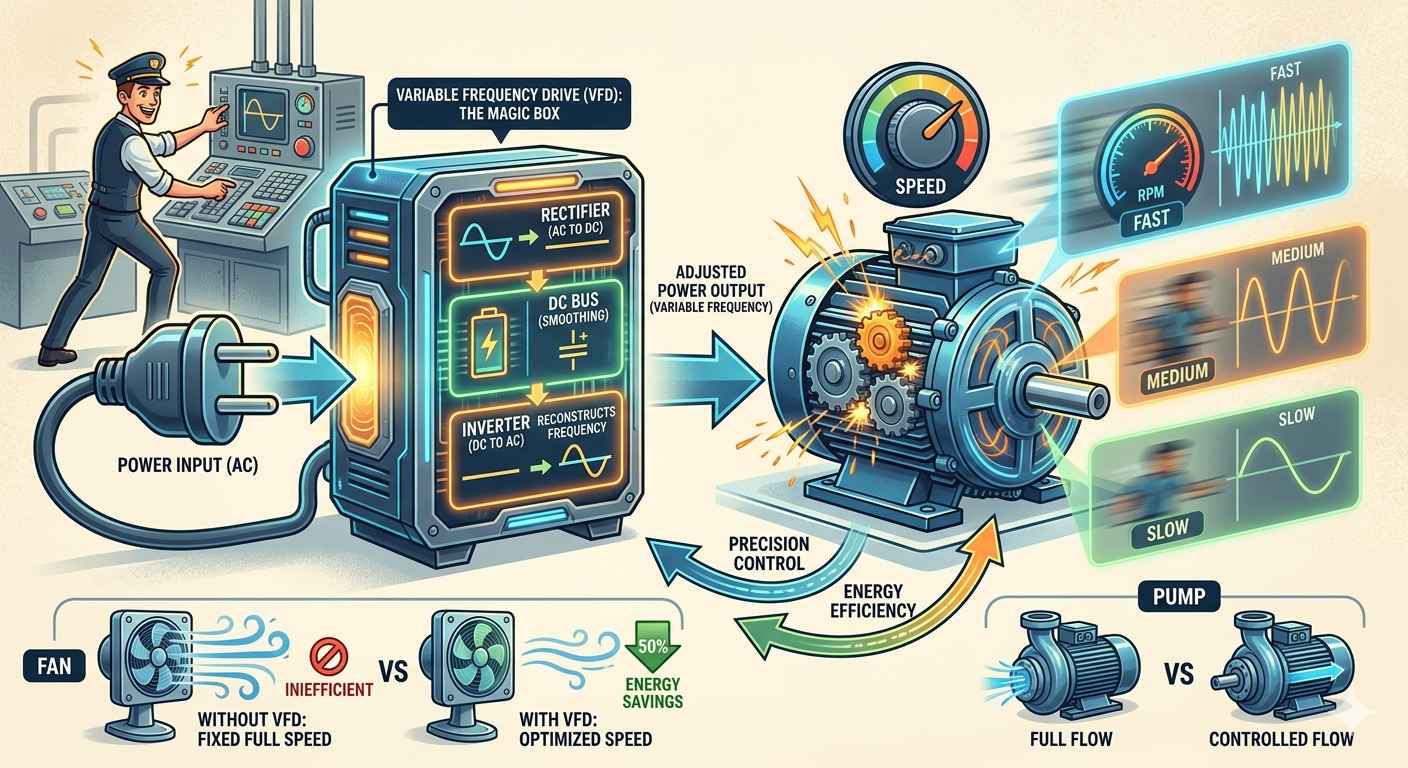
How Does a VFD Control Motor Speed? A Simple Guide to Efficiency
Sample provide:
YESSample freight payer:
BuyerTerm of payment:
T/T, L/C, D/PCustomized:
YESWarranty:
18 MonthsDelivery Time:
5-7 working days for standard series; 7-14 working days for customized AC drivesTransportation:
Express · Sea freight · Land freight · Air freightPackage:
Standard Export Package Carton/WoodAvailability:
OEM/ODM, Minmum Order RequestPlace of Origin:
ChinaShipping Port:
ShandongCertification:
CE, EAC, ISO9001, OHSAS18001, TS16949, SGSIf you are interested in our products and want to know more details,please leave a message here,we will reply you as soon as we can.
Categories

As the VFD manufacturer in china, V&T has rich experience in electric drive fields. V&T V6-H series is a high performance vector control and torque control AC inverter.The product adopts close-loop vector control technology and torque control technology which are synchronized with the current international advanced technology, and it has the same excellent control performance with the international high-end frequency drive.

IoT Module AIEC-IOT-WL

As the VFD supplier in china, V&T has rich experience in electric drive fields. 220V V5-H series is a high-performance vector control VFD inverter. The product adopts open-loop vector control technology which is completely synchronized with the most advanced technology in the world. It has the excellent control performance with the international high-end AC drive. At the same time, It is combined with the use characteristics of China, and the reliability and environmental adaptability of the products are further strengthened, and the customized and professional design greatly meet the needs of various transmission applications.

As the VFD manufacturer in china, V&T has rich experience in electric drive fields. V&T E5-H series is a high performance universal vector control inverter with superior performance-price ratio and powerful control functions. It is widely used in various drive and speed regulation in the fields of machine tools, food, paper making, metallurgy, chemical industry, wire and cable, power, textile and transmission.

As the VFD manufacturer in china, V&T has rich experience in electric drive fields. V&T V9−H Series General Purpose Inverter is a high-performance vector control and torque controlled frequency drive. Vector control technology and torque control technology are employed. It can better meet the needs of various transmission applications.Voltage range covers 200V, 400V, 690V, and 1140V. The product power range covers 0.4kW to 3MW.

Human Machine Interface

V5-IS asynchronous servo series is a high-performance special-purposed AC drive for Injection molding machine. The product adopts open-loop vector control technology which is completely synchronized with the most advanced technology in the world. It has the excellent control performance with the international high-end AC drive. At the same time, It is combined with the use characteristics of China, and the reliability and environmental adaptability of the products are further strengthened, and the customized and professional design greatly meet the needs of various transmission applications.
 Yanzhuang Industrial Zone, Gangcheng District, Jinan City, Shandong Province, China
 Ms. Nina


If you are interested in our products and want to know more details,please leave a message here,we will reply you as soon as we can.
Copyright © 2025 Shandong Lianchuang Gaoke Automation Co.,Ltd.. All Rights Reserved. Power by

IPv6 network supported


